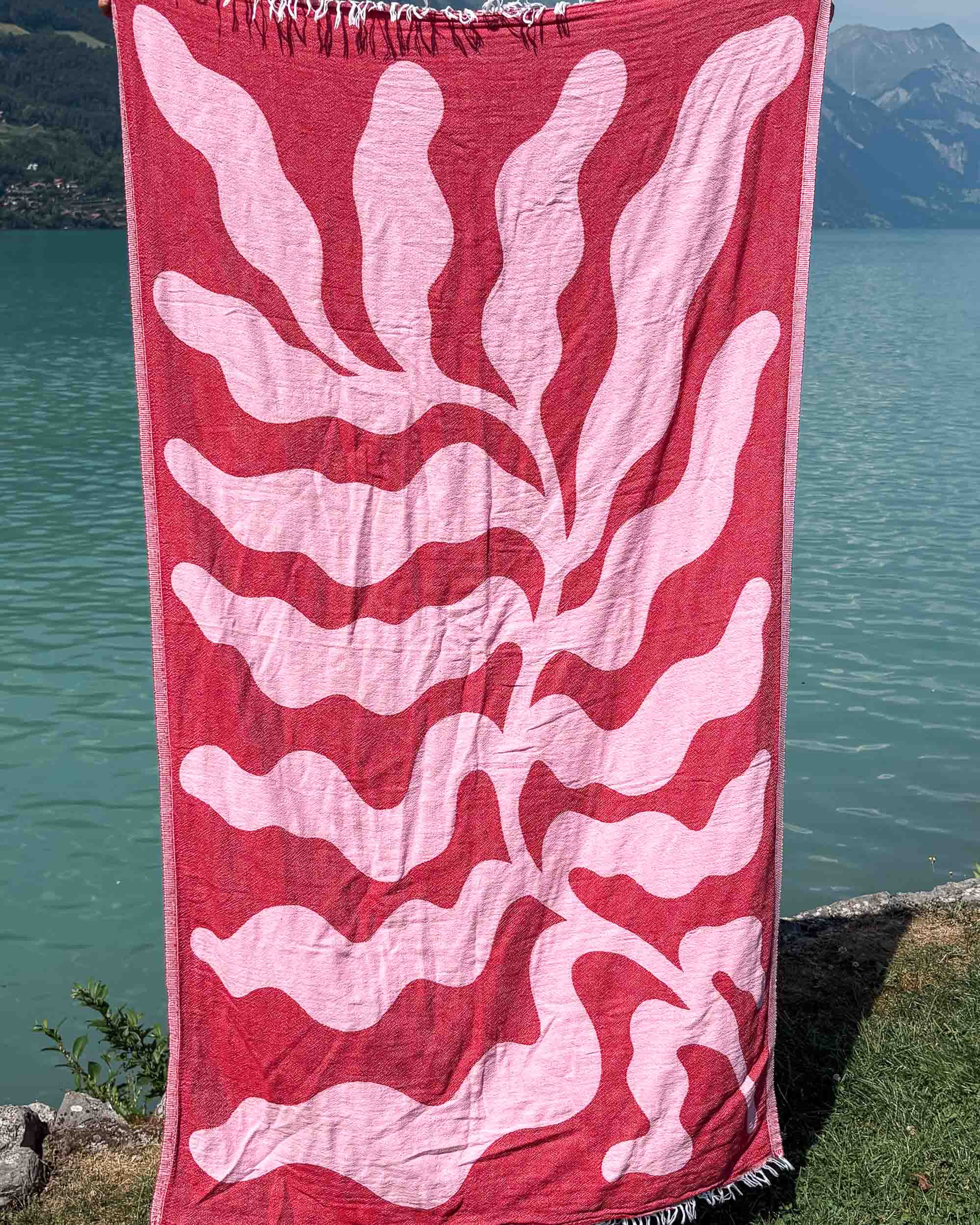


Imagine yourself on the board, for the first time. The wave carries you, the sea holds you. Everything feels light. Learn to surf holidays open precisely this door – to a feeling you will never forget. It's not just about learning to surf. It's about freedom, connection with nature, and rediscovering yourself. Once you've had a taste, you know: the ocean becomes home.
Why learn to surf holidays are more than just a vacation
A surf vacation to learn is not an ordinary trip. You dive into a rhythm that has nothing to do with everyday life. In the morning, you go into the water; in the evening, you sit on the beach. In between: movement, sun, salty skin.
The Ocean as Your Teacher
You don't learn surfing from books. You learn it in the water, wave by wave. On learn to surf holidays, you're in the ocean every day, observing the sets, feeling the current, understanding the swell. It's physical, but also mental. You learn to let go, to be patient, to adapt.
That's what makes surf vacations so valuable: they challenge you without overwhelming you. And they give you time – time with yourself, with the ocean, with people who are looking for the same thing as you.
The right destination for your first surf holiday
Not every spot is suitable for beginners. Learn to surf holidays work best in places that offer gentle waves, warm water, and a relaxed atmosphere.
Europe: Close, warm, perfect
Portugal remains the classic. The Algarve and the Ericeira region offer consistent waves, warm temperatures, and a surf community that welcomes beginners. France – especially Hossegor and Biarritz – also magically attracts surf learners.
Spain scores with the Canary Islands and northern coast spots like San Sebastian. Here you'll find waves and a mild climate all year round.
- Portugal: Consistent waves, surf culture, beginner-friendly breaks
- France: Long sandy beaches, powerful waves, relaxed vibe
- Spain: Variety of spots, warm water, year-round conditions
Long-haul destinations: Bali, Costa Rica, Morocco
For those who want to go further afield, Bali offers the perfect mix of culture, nature, and gentle waves. Canggu and Kuta are ideal for beginners. Costa Rica offers fantastic conditions on both coasts – Tamarindo and Nosara are particularly popular.
Morocco surprises with spots like Taghazout: warm water, consistent swells, and an authentic, tranquil atmosphere.
| Destination | Best travel time | Wave level | Special feature |
|---|---|---|---|
| Portugal | May–September | Beginner–Intermediate | Consistent, close, European |
| Bali | April–October | Beginner–Advanced | Culture, warm water |
| Costa Rica | December–April | Beginner–Intermediate | Jungle meets Ocean |
| Morocco | September–April | Beginner–Advanced | Authentic, affordable |
What makes a good learn to surf holiday
Not every surf vacation is the same. Some offers truly advance you – while others remain superficial.
Small groups, genuine support
The best learn to surf holidays focus on small groups. A maximum of six to eight participants per instructor. This way, you get individual tips, corrections, and encouragement. You learn faster and more safely.
Good surf camps offer multiple sessions per day: in the morning when the sea is calm, and in the afternoon for a second wave. In between, there's time for video feedback, theory, or just relaxing.
Equipment that fits and lasts
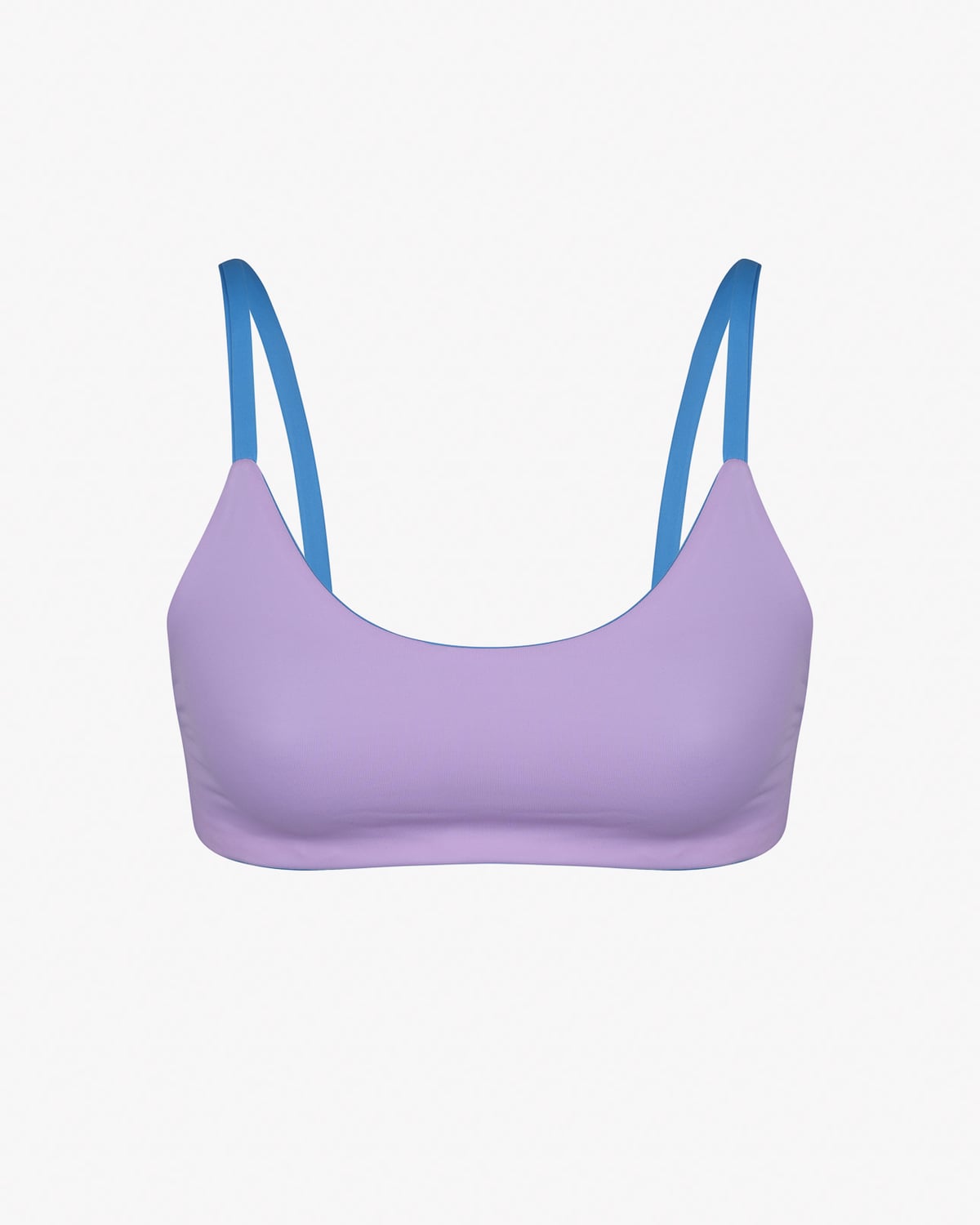
A softboard for the first few days is standard. But you also need a wetsuit that fits, and most importantly: swimwear that really stays put. Nothing is more frustrating than constantly having to adjust your bikini top while trying to stay on the board.
Surf bikinis are specifically designed to withstand the demands of the water. They fit securely, don't slip, and give you the confidence to fully concentrate on surfing. Especially in the lineup, when you're waiting, paddling, or catching a wave, you don't want to have to think about your swimwear.
Camp location and vibe
The location determines the overall experience. A camp directly on the beach saves time and energy. You wake up, go into the water, come back, shower, eat. Everything flows.
Also pay attention to the atmosphere: Do you want party and social vibes or rather peace, yoga, nature? Both are possible – you just need to know what suits you.
How to prepare for learn to surf holidays
Surfing is physically demanding. Those who are fit have more fun and less muscle soreness.
Fitness: Strength, Balance, Endurance
Surfing demands shoulders, back, and core. Swimming is the perfect preparation – it strengthens paddling muscles and builds endurance. Yoga also helps immensely: balance, flexibility, breath control.
A few weeks before your trip, you can start with these exercises:
- Planks for core stability
- Push-ups for shoulders and arms
- Squats for leg strength during pop-ups
- Burpees for explosive power and endurance
- Swimming – ideally crawl, at least twice a week
Mental Preparation: Patience and Openness
Surfing is trial and error. You will fall. Often. That's part of it. Those who accept this will have more fun. Learn to surf holidays are not a sprint – they are an immersion into a new rhythm.
Let go of expectations. Be open to what comes. Sometimes the best moments are when you just sit in the water and watch the ocean.
What to pack
Less is more – but a few things are indispensable.
Swimwear that performs
As mentioned: Invest in high-quality surf swimwear. A bikini that slips will cost you energy and concentration. Sustainable swimwear made from recycled materials not only protects the environment but also provides the necessary support.
For cooler destinations, you'll need a wetsuit – usually provided by the camp. But your own rashguard (Lycra shirt) protects against sun and chafing.
Sun protection and care
The sun at the sea is intense. Even when it's cloudy. Pack:
- Sunscreen (mineral, reef-safe, SPF 50)
- Zinc paste for nose and lips
- After-sun lotion or aloe vera
- Headwear for breaks on the beach
- Sunglasses with UV protection
Practical items for everyday use
A small backpack or a waterproof bag for the walk to the beach. Flip-flops. A microfiber towel that dries quickly. Perhaps a journal to record your progress.
Typical daily routine on learn to surf holidays
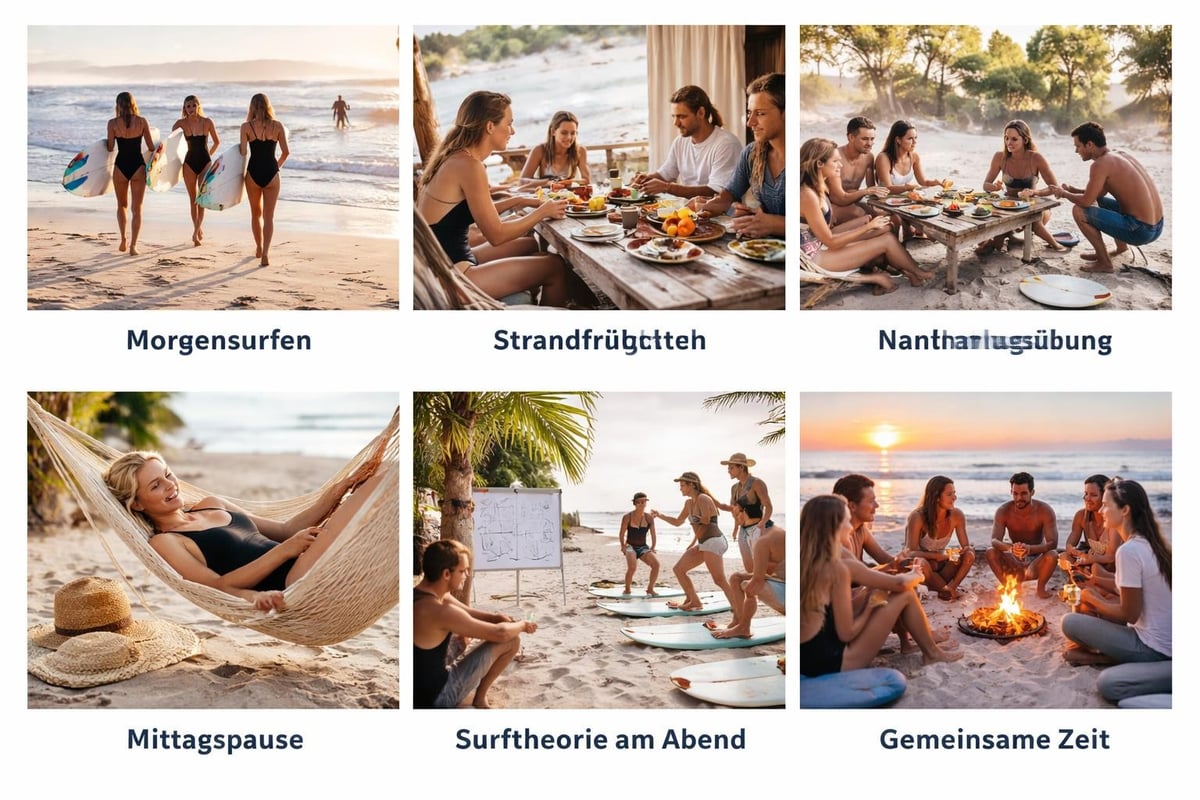
Every day follows a similar rhythm – and that's exactly what makes it so relaxing.
Morning: The best session
Waking up early is worth it. The sea is calm, the waves clean, the beaches empty. After a light breakfast, you go straight into the water. The first session usually lasts two to three hours. Afterwards, you're tired – in a good way.
Midday: Rest and recovery
Back at camp, there's brunch or lunch. Afterwards: rest, read, chill by the pool. Some camps offer yoga or massages. Others show video analyses of your surf session.
This break is important. Your body needs it to recover.
Afternoon and evening: Second round or free time
Depending on the spot conditions, there's a second session in the late afternoon. Or you use the time to explore the surroundings – a village, a market, a sunset.
In the evening, everyone eats, talks, and laughs together. Some camps organize bonfires or movie nights. You go to bed early – the sea awaits tomorrow.
The essential surf basics you'll learn
Learn to surf holidays teach you the fundamentals – step by step.
Paddling and positioning
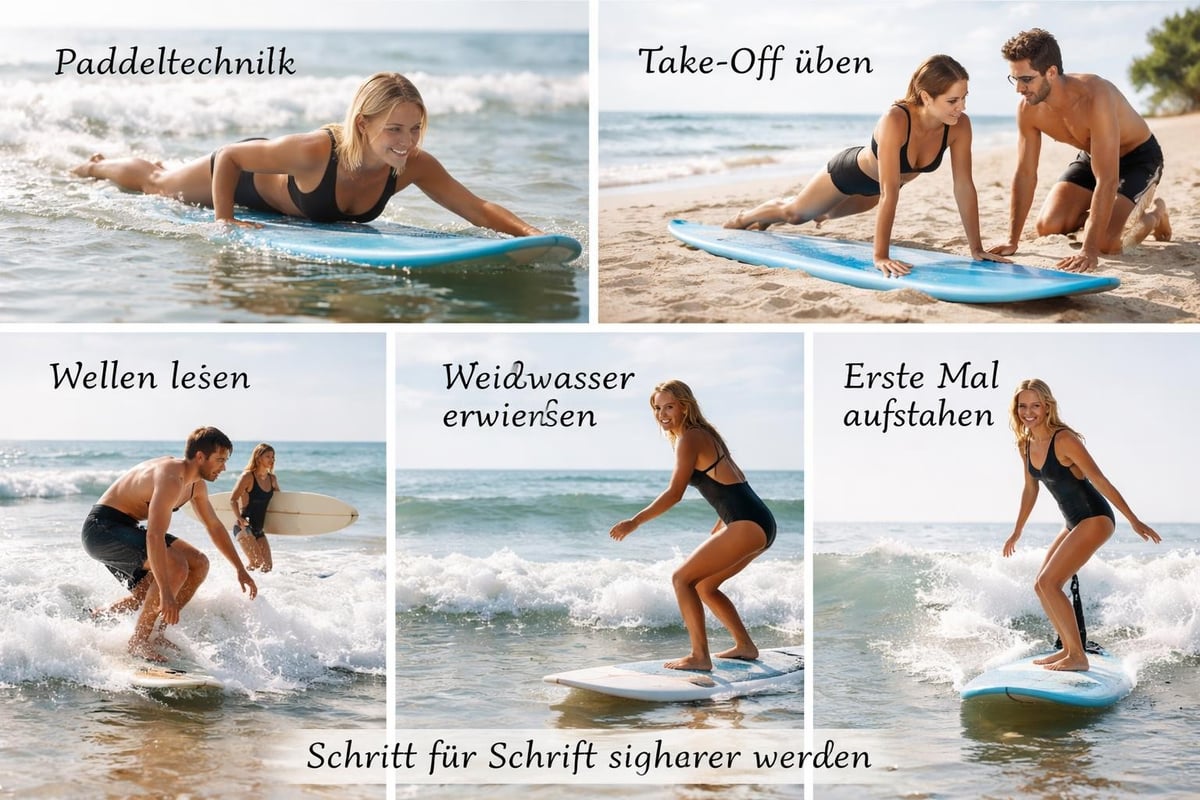
Before you can stand up, you need to be able to paddle. Paddling correctly saves energy and gets you into position. You learn how to lie on the board, how to move your arms, how to get through the waves.
Positioning is the art of being in the right place at the right time. You observe where the waves break, where other surfers are sitting, how the current flows.
The pop-up: From lying to standing
The pop-up is the central movement. In one fluid motion, you jump from lying down to standing on your feet. Initially, you practice this on the beach, later in the whitewater, and finally on the green wave.
It takes practice. But eventually, you get it – and then you'll never forget it.
Wave selection and timing
Not every wave is good. You learn to choose the right ones: not too big, not too fast, with enough power. Timing is everything. Too early, and the wave leaves you behind. Too late, and it breaks over you.
| Surf Skill | What you learn | When it clicks |
|---|---|---|
| Paddling | Strength, efficiency, perseverance | After 2–3 days |
| Pop-up | Movement sequence, balance | After 4–5 days |
| Wave selection | Observation, timing, intuition | After 1–2 weeks |
| Direction changes | Weight shifting, control | After 2 weeks |
Surf etiquette: Respect in the lineup
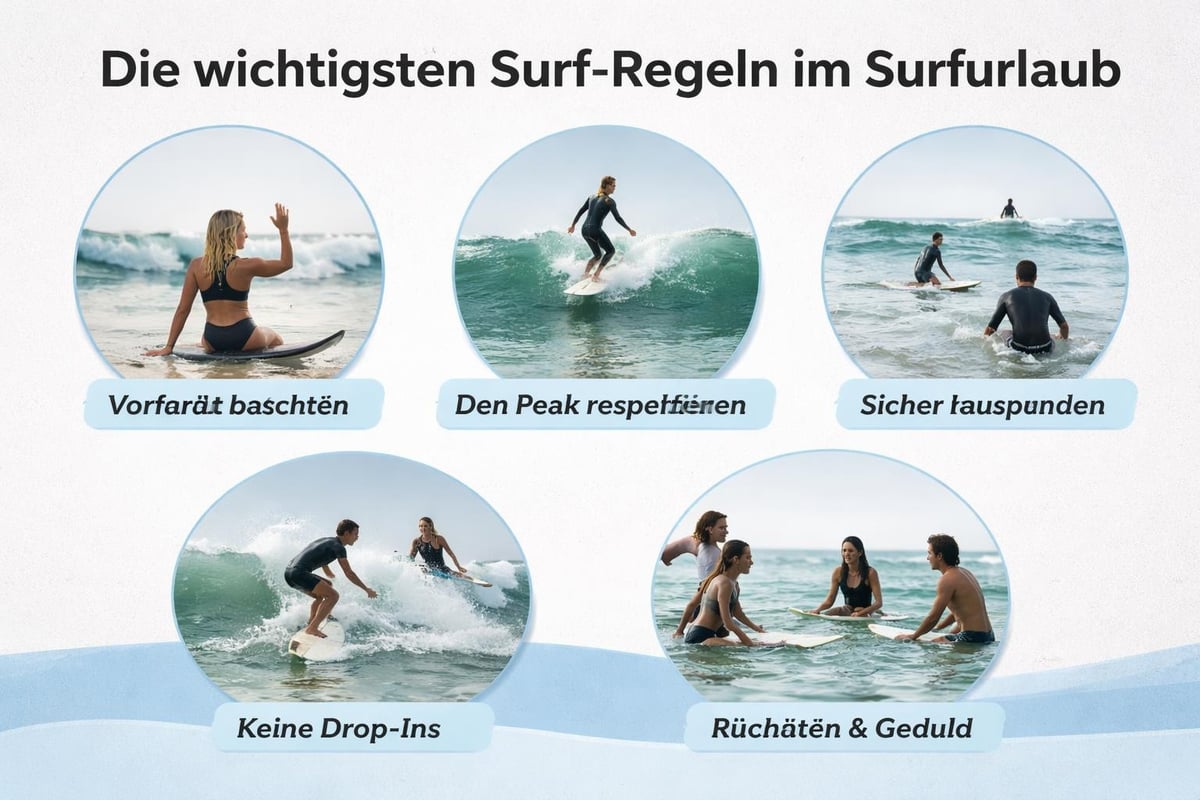
Surfing has rules. Those who know and respect them are respected.
Right of way and avoiding drop-ins
Whoever is closer to the peak has the right of way. If you paddle onto a wave someone is already surfing, it's called a "drop-in" – and that's absolutely unacceptable. Always look around before taking a wave.
Communication and consideration
A nod, a hand signal – in the water, communication is non-verbal. Be friendly, helpful, patient. Surf communities appreciate that.
If you're in someone's way, paddle aside. If you fall, protect your head and watch out for your board – it can become a danger to others.
Why sustainable swimwear matters on learn to surf holidays
The ocean gives us so much. It's up to us to protect it.
Recycled materials, less waste
Sustainable swimwear is made from recycled fishing nets, PET bottles, or old textiles. Each piece reduces waste and conserves resources. For surfers who are in the ocean daily, this is not a nice-to-have – it's a principle.
Durability over fast fashion
Cheap bikinis last one season. High-quality surf swimwear lasts for years. It's robust, shape-retaining, and UV-resistant. This saves money and protects the environment.
Those who buy consciously invest in quality – and in the future of the oceans.
After the learn to surf holidays: Keep at it
The vacation ends. But surfing doesn't have to end.
Surf communities at home
Even in Switzerland, Germany, and Austria, there are opportunities: river waves, surf pools, indoor facilities. They don't replace the sea, but they keep you in shape.
Plan your next trip
Once you've started, you'll want more. Maybe your first surf holiday was in Portugal – the next takes you to Bali. Or Morocco. Or Central America.
Every spot is different. Every wave teaches you something new. Learn to surf holidays are the beginning of a long, beautiful journey.
Learn to surf holidays combine movement, nature, and inner freedom in a way that resonates. With the right preparation, a suitable camp, and high-quality equipment, your first surf holiday will be unforgettable. Discover sustainable swimwear at MAIN Design – Your Daily Dose Of Summer that delivers what it promises in the water – and protects the oceans with every purchase.